Installation and configuration
Note
The software is in active development, and while we do our best to ensure that there are no issues present, there might be some. We welcome bug reports and feature requests on the GitHub repository.
Executable
Once the requirements described in System requirements, are installed and working correctly, the user can download and unzip the provided iDaVIE.1.0.zip, which contains the executable .exe (and other reference files). The zip file is available on Github at this link.
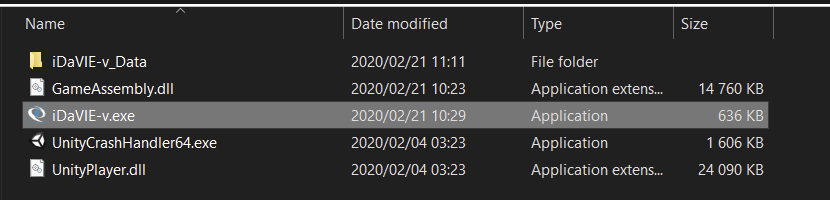
To start the software, double-click on the executable iDaVIE file.
Source code
Please see Building iDaVIE from source for instructions on building iDaVIE from the source code. We also provide detailed Contributing to the iDaVIE project guidelines.
Configuration File
The first time iDaVIE is launched, a file named config.json will be generated in the main directory where the executable is located. This file contains the default configuration settings for the software. The user can modify this file to customize the software to their needs. The configuration file has the following settings that can be modified:
Config Options
Configuration Setting |
Description |
|---|---|
$schema |
The URI of the JSON schema used for validation and code completion with JSON editors. This should not be modified. |
maxModeDownsampling |
Use maximum-mode downsampling when reducing cube size before uploading to the GPU. This takes the maximum values of the 3D windows of voxels (depending on downsampling factors needed to reduce the cube size to be under gpuMemoryLimitMb) and sets individual voxels to those values in the downsampled version of the cube. Setting to that sets the voxel values to the average of the 3D windows. The downsampling algorithm can be found here in the iDaVIE source code. Default: |
foveatedRendering |
Use static foveated rendering to improve rendering performance at the expense of image quality in the periphery of the headset display. Default: |
bilinearFiltering |
Use bilinear filtering when sampling from the data texture on the GPU. Smooths cube appearance at the expense of performance. It is recommended to leave on more obvious definition. Default: |
gpuMemoryLimitMb |
Maximum size (in megabytes) of cubes uploaded to the GPU. Cubes larger than this limit will be downsampled before GPU upload. Stronger GPUs can push this limit higher. Default: |
maxRaymarchingSteps |
Maximum number of raymarching steps to take when rendering the cube. A larger number of steps will improve cube appearance when large cubes are used, at the expense of performance. Default: |
angleCoordFormat |
Format for angle coordinates. Options: |
velocityUnit |
Unit for velocity. Options: |
defaultColorMap |
Default colour map to apply when loading a new cube. Options: Any of those on this list of matplotlib maps. Default: |
defaultScalingType |
Default scaling type to use when applying the colour map to a cube. Options:
|
voiceCommandConfidenceLevel |
Confidence level threshold to use when recognizing voice commands. Options: Default: |
flags |
The different flag strings that can be applied to sources in a source list, and exported with them. Other suggested flags can be letters or quality (i.e. “Good”, “Bad”, etc.). Default: |
histogramIncrementSteps |
The number of steps that make up the full range of the min/max scaling for the histogram in the VR Plots window. Default: |
histogramStepsPerSecond |
The number of steps per second when incrementing the histogram min/max scales in the VR Plots window. Default: |
useQuickModeForPercentiles |
Use the quick, less precise percentile calculation for the scale min/max that uses the histogram instead of the full data set when selecting pre-defined histogram percentiles for the min/max scales in the desktop GUI. Default: |
restFrequenciesGHz |
Rest frequencies in GHz that can be chosen in the desktop or VR GUIs. These are used for frequency <-> velocity conversions. Add more to avoid typing in manually every session. Default:
|
tunnellingVignetteOn |
Enable tunnelling vignette that adds black region in headset peripheries. Default: |
tunnellingVignetteIntensity |
Intensity of the tunnelling vignette. Default: |
tunnellingVignetteEnd |
End value of the tunnelling vignette. This is how far the vignette extends into the view. Default: |
displayCursorInfoOutsideCube |
Allow the controller to display information outside the volume cube. Default: |
displayVoiceCommandStatus |
Display the voice command status in the cursor information. Default: |
usePushToTalk |
Enable the requirement that the secondary button on the primary controller must be held down to use voice commands. This is recommended for noisy environments. Default: |
useSimpleVoiceCommandStatus |
Use the simple voice command status indicator. This displays simple icons to indicate the status of voice commands. Setting this to false uses a more informative text version. Default: |
importedFeaturesStartVisible |
Imported sources start visible. Default: |
Moment Maps Config Options
Moment Map Setting |
Description |
|---|---|
momentMaps.defaultThresholdType |
Default threshold type to use when calculating moment maps. Options: |
momentMaps.defaultLimitType |
Default limit type to use when rendering moment maps. Options: |
momentMaps.defaultThreshold |
Default threshold value to use when calculating moment maps with a threshold type. Default: |
momentMaps.mom1MaskThreshold |
Mask threshold for M1 moment map. Default: |
momentMaps.m0.colorMap |
Colour map for M0 moment map. Options include any of the colourmaps found here. Default: |
momentMaps.m0.scalingType |
Scaling type for M0 moment map. Options are the same as defaultScalingType. Default: |
momentMaps.m1.colorMap |
Colour map for M1 moment map. Options include any of the colourmaps found here. Default: |
momentMaps.m1.scalingType |
Scaling type for M1 moment map. Options are the same as defaultScalingType. Default: |
Troubleshooting
In this section we share some useful tips where we found a solution to a known issue:
Under some circumstances, the voice commands stop working. If this happens, we found that the following sequence of actions usually solves the problem (NOTE: this solution has been tested only with Oculus Rift S and on machines where the RealTek Audio driver is installed, we cannot assure it will work for all configurations)
take the headset off
make sure the iDaVIE Desktop GUI is front and centre and no other windows are in front of it
use the Windows search function (lower left hand corner - says Type here to search), and type audio
open the RealTek Audio Console that will apper after the search
check that the Microphone is set to maxium; toggle <mute> on and then off. Now the mic should be on and ready to receive commands.
close the Audio Console
put the headset back on and use the voice commands as normal.
If errors are encountered that you can’t solve, please:
Post an issue on the Github repository, or,
Make contact with us and send us the log files along with your bug reports. The log files can be found in the directory
iDaVIE/Outputs/Logs.
Warning
Unity only allows for a maximum of two log files to be stored. Therefore, if a problem is encountered with iDaVIE, make sure to copy the log file to a different folder BEFORE starting a new iDaVIE session, otherwise the log file reporting the specific problem encountered will be lost.
Known issues
The following are issues we already know about and that will be fixed as soon as possible:
Problem with virus protection systems. We will make a request to Norton to have our software “whitelisted”. In the meantime the virus protection does not recognize the .exe and puts up the warning.